Friday, February 13, 2015

Some more ruminations on reading

Being critical of books isn't a bad thing. I always find it funny when students apologize to me for not liking a novel we've read in class. My stock response is always, "Why are you apologizing to me? I didn't write it."
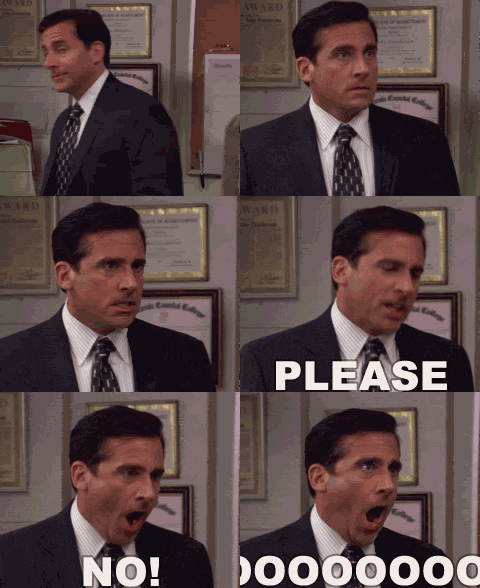
This is me when I hear any Miley Cyrus song on the radio.
I understand that not all books will resonate with all students. Even novels that overwhelmingly receive rave reviews from students, like Markus Zusak's I am the Messenger, leave some students unimpressed or uninspired. The inability to get 100% of students to like a book does not make me feel like a failure as a teacher, nor does it make a book a bad book.

Just like with any other piece of art, music, or film, everyone's tastes differ. My preference for country music does not demand that others listen to it any more than I should be subjected to Miley Cyrus. (Just. No.)

However, I have learned, not only through the course of finding my way back to reading for enjoyment, but also through being an English major, that books, like many new things in life that are presented to us, deserve a sincere attempt.

Don't be jealous of my amazing HP costume.
If I stuck to my narrow-minded view of fantasy back in the spring of 2001, when I was a junior in college who believed her roommate was a wacko talking about wizards and muggles, I would have missed out on a literary world of wonder. Similarly, to have dismissed the Harry Potter series simply because it was Children's or Young Adult--a term that thankfully has lost much of the negative connotation it once held through other wonderful writers like John Green-- would have stripped me of the ability to find comfort and escape in re-reading the magic of words when I was going through a hard period of my life.

Not every book I've given a sincere attempt at has worked out so nicely, however. To this day, The Time Traveler's Wife, a book the boasts 4.5 stars out of 5 on Barnes & Noble, has a bookmark stuck in the pages about a third of the way through. It was the first book in my life I've given myself permission to "Miley Cyrus" (I'm making it a verb now) and just say no to. There was nothing in either of the characters I cared about, so I figured, why keep reading?

It is important to note here that I was reading Time Traveler's for my own enjoyment, and not for a class. There have been plenty of school-assigned titles I wasn't pumped about reading: Tartuffe comes to mind. Pure torture. But for every Tartuffe the was a Magus. John Fowles's postmodern head game that is The Magus was an intense read because I could not lose focus for a second. It was to me what A Tale of Two Cities is to my freshmen. Complex, layered, and hard work--but worth every second of that work.

I walked away from The Magus experience with a much deeper understanding of the individual and was able to connect that lesson of self-knowledge to the self I was in the midst of defining as I neared the end of my college tenure; however, I would not have been able to get that depth of understanding had I read The Magus on my own. I'd have been in way over my head without the discussions with my peers and the probing questions of my professor.  

In the same vein, I hope students walk away from A Tale of Two Cities appreciating the power of stepping up, doing what is right, and choosing love over hate, even if they kicked and screamed the whole way through, because I was able to guide, to explain, to clarify, and, hopefully to infuse some of my own passion for the characters in them. Again, I'm not delusional that all will feel that way, but end-of-the-year surveys tend to play out OK for 'ole Dickens.

While there needs to be room for contemporary titles where the language might be easier to understand, but the lessons and issues are no less complex, hard work and thinking are not fatal, especially in the classroom where there is a coach to help guide students along.  I strive to strike a balance between classic and contemporary in the classroom. However, students can do themselves a favor by picking up a book outside of class, one aligned with their interests and tastes, to keep their minds sharp and primed to tackle the more difficult texts that will be presented in the classroom. 

As with any skill one hopes to develop, practice makes perfect. The brain is a muscle in constant need of conditioning. However mundane the drills may seem, a student can't hope to master the curve if (s)he never takes some practice swings.


Friday, January 30, 2015

Time Well Wasted*

If you’ve looked at the “What I’m Reading” section of this blog, you’ve noticed that last year I challenged myself to read one non-school related book a month for 2014. At the conclusion of 2014, I was quite pleased to find that meeting the 12-book challenge was easier than I anticipated, so much so that I’ve upped the ante this year and set my goal at 20 books for the year.

Over the next few blogs, I’m going to be talking about things I learned, or relearned, through the course of getting back into reading for enjoyment, rather than reading as a chore or a checklist I have to get through for work.

One truth is that making time for reading is not hard.

When I first started the challenge, I knew my children would not be the most helpful in allowing me to meet my goal. They’re young, like a great deal of attention, and when they’re not given it, find other ways of entertaining themselves which typically end in the dismantling of one or more rooms in the house.

The other obstacle was the fact that I already read quite extensively for my job. Between books for each of my classes (yes, I re-read all books, every year!) and the writing assignments students complete, I’m reading constantly. How was I going to find not only the time but also the energy to add to my daily reading?

I started by setting a goal: I’d dedicate the half hour before going to sleep to reading. By that point, the kids would be in bed, and any work I‘d have to get done for the following day would be completed. Once I established the routine, I figured it’d be easy to stick to.

The problem was that I started off reading books that would not stand for a 30-minutes-a-night limitation. The first book of 2014 was Jennifer Donnelly’s Tea Rose. To say that I couldn’t put it down would be an understatement. I’d go so far as to say I nearly neglected my children for the book. I say nearly because their basic needs were all taken care of throughout the course of my reading the novel. They may have watched more episodes of Mickey Mouse Clubhouse during that period of time, though. 

I found that if the book were good enough, I’d find the time to read. If I arrived somewhere early or was sitting in the doctor’s office waiting for an appointment, I’d have my Kindle, or my phone with the Kindle app, that allowed me to squeeze in a few pages or chapters during down time.

The more time I spent with Donnelly’s characters, the less I cared about other “stuff” I was missing: the latest episode of The Big Bang Theory or Modern Family, and the time wasted scrolling through my timeline on Facebook or pinning baking feats on Pinterest that 90% of the time end in complete failure.
I crack up every time I look at this.
The unexpected lesson in making time for something I always enjoyed, and had allowed to get away from me?  I was actually more present in other areas of my life.  I disconnected from being connected to everything, deleting time-sucking apps from my phone that I learned I didn’t miss while spending time reading—so why would I miss them while hanging out in the backyard with my family, or out to dinner with my friends?

Reading seems, on the surface, to be an isolating activity. But when I think of the conversations I’ve had throughout the course of the year with relatives and friends about the books I’ve read or when I think of the excerpts that connect to lessons I’ll teach to, and discuss with, my students, I realize just how shallow that judgment is.

Finding time to read has allowed me to assess and prioritize how and where I spend my precious time. As I enter into another year and a new reading challenge, I am much more content replacing vacuous status updates with a tea entrepreneur, a Scottish Highlander and his time traveling wife, and a blind young woman as she tries to survive occupied France during WWII.

That’s some time well wasted.

*To borrow a phrase from Brad Paisley 

Friday, December 5, 2014

Realizing my Dream

The last dream of my soul is in the process of coming true. For as long as I can remember, I've wanted to emulate my mother. The balance of encouragement and tough love, the freedom to figure things out for myself, as well as the knowledge that I'd have support if I fell, allowed me to figure things out for myself. She would guide, but not control.

In serendipitous fashion, I purchased Garth Brooks's new CD this week, as I've been figuring out how to present what the last dream of my soul is. There is one song on this album that speaks so beautifully to what my mom provided me, and what I ultimately want to provide my children: freedom to grow, to learn, to mess up, to try again--in short, to navigate the world with confidence built upon accomplishments of their own doing.

The song, "Send 'em on Down the Road" is my parenting credo. In the chorus, Brooks sings, "you can help them find their wings/But you can't fly for 'em/'Cause if they're not free to fall/Then they're not free at all"(Beeson/Shamblin).

I find that my parenting philosophy is closely connected to my teaching one; it is quite likely that my time in the classroom has only bolstered my resolve that my children need to be given the freedom to not get it right the first time so they can experience the satisfaction of perseverance, and the independence of completing the task before them even though they struggled.

Also serendipitous is that through reading all of your "Last Dream" essays, I'm finding myself commenting that the first step of achieving your dream is to set the intention--in the words of William Arthur Ward, "if you can imagine it, you can achieve it; if you can dream it, you can become it." Thus, I want to share with you an essay I wrote in high school--the beginning of the last dream of my soul, that I find coming true step-by-step, and that will hopefully continue to unfold in the manner I have planned.

Works Cited:

Beeson, Marc, Shamblin, Allen. "Send 'em on Down the Road." Man Against 
          Machine. Perf. Garth Brooks. RCA, 2014. CD. 

***

The Woman I want to Be

One of my favorite places:
Ham-Smith at UNH
The sun warms thoughts of jubilation as I rise for the finale of my four years as a UNH Wildcat.  Semblances of relief, pride and accomplishment scurry in synchronization through my mind.  As I ascend another rung in the ladder of my years, I recall the prominent female figure in my life who has shared her wisdom and learned from her mistakes; she has inculcated me to follow.  Through me she will forever endure.

As my life’s path guides me to my occupation, the countenance of my mother is embedded in my mind’s eye; pride and encouragement are evinced on her face.  This encouragement allows me to imagine the myriad of students I will one day inspire.  The determination she has instilled in me will reap its rewards with my promotion to department head of the English Department and the renowned debut novel I will one day compose.
My husband and I on our wedding day.

Upon savoring the sweet taste of success, I am propelled into marital bliss.  I portray my mother in my new role as wife.  I have received her wit and good humor; both of which endear my love to my whimsical stories.  My husband’s strong arms embrace me as we talk by the fire of all that occupies our thoughts.  To him I show passion in my beliefs and my inner clarity, as did my mother to my father.  Like my mother I am confident in who I am, and will not sacrifice my individuality. 
With my kids at the Halloween Parade

I will convey this same cardinal confidence in my children.  No being will ever tell my children what they can and cannot do.  Their inner clarity allows them to one day navigate their own destinies, as my mother urged me to do.

My mom and me at my friend's wedding.
As the organist begins to play "The Wedding March", new feelings of relief, pride and accomplishment scurry in synchronization through my mind.  My daughter is being escorted down the aisle on her father’s arm, while tears of descend from my eyes.  I taught her everything a woman should be.  I am assured she is my greatest accomplishment.  I have passed onto her all the wisdom of my mother, the woman I want to be.

Thursday, November 20, 2014

She'll be there

I come from a large extended family, both on my father’s and my mother’s sides. While many people dread spending time with relatives, especially large groups of them in smaller than ideal spaces, I relish it. 

My appreciation for my extended family could stem from the fact that I grew up with my grandparents and the majority of my aunts, uncles and cousins close by, as close as next door or a few streets away. Adding to the close proximity of my family is the fact they are awesome people. 

While every family has to negotiate the delicate which-side-of-the-family-will-we-celebrate-with-this-year issue, over the last few decades Thanksgiving has traditionally been celebrated with my maternal family. Even if not everyone in the extended family arrived for 1:00 lunch, they would trickle into my parents’ house after their lunch or early dinners celebrated with the other side of their families, for Haley Thanksgiving.

Card games were played, karaoke songs belted out, sometimes in tune, often not, and inevitably, my dad would invent some new word as he loudly expressed his opinions on politics, religion or pop culture. Some of my favorites: when he was talking about that “Harvey Bolito” song you hear at church—known to everyone else as “Ave Maria”—or when he proclaimed the automation in Lion King to be incredible. We even started Bob’s Thesaurus to keep track of his malapropisms.

As the years passed, adopted members of the family would join us. My brother’s friends and mine would come join in the festivities, and then some cousins’ friends began to follow suit. One of my favorite “adopted Haley” moments was when my cousin Tommy’s friend Dave brought his guitar. We stood around him joining in the chorus of Barry McGuire’s “Eve of Destruction,” which then lead to more sing-alongs. A family favorite? Feliz Navidad. It was such a favorite, that if we got together at different times in the year, we would still sing it loud, even in the dead of the summer.

Ma's apple tree, with Tommy back on top.
But at the core of it all was my grandmother, Ma. She was the center to which we were all pulled. We all wanted to be the apple of Ma’s eye—and the top of her Grandmother apple tree. There is a running joke about the favorite grandchild in our family. Ma had a wooden plaque with the painting of an apple tree. Each apple had a grandchild’s name. As we were born, we were placed on the apple tree, with eldest grandchild's apple, my cousin Tommy,  proudly hanging at the top.

Tommy’s participation in a semester abroad in England coincided with my Ma re-wallpapering her dining room. To match the new wallpaper, my mother took the tree home, repainted it, and repainted the grandchildren by family rather than birth-order. Tommy returned to the States to find he had been demoted from top apple. We began competing, trying to give the best gifts or succumbing to brown-nosing in general for the chance to be top apple. Tommy went so far as to write her a song one Christmas which was performed that Christmas Eve, and many Christmases, Thanksgivings, Mother’s Days, and random family gatherings after the fact.
Ma, our matriarch

The last time we all sang the Ma Song was in February at her funeral collation.

This will be our first Thanksgiving without Ma. It’s just starting to hit me that she won’t be sitting in my parents’ kitchen when I walk over after I have my Thanksgiving lunch with my in-laws. Her peanut butter cups and apple pie will not be sitting on the counter, waiting for us to attack. The low hum that she used to unknowingly emit will not fill the gaps in conversation.

She won’t be sitting there, but she’ll be there. She’ll be in the stories we’ll tell and the memories we’ll share. She’ll be there in the recipes cooked—they won’t be Ma’s peanut butter cups or apple pie, but someone will have stepped up to fill the space on the counter with her confectionary goodness. She’ll be there in the pieces of herself she’s handed down to each of us.

For me, she’ll be there in my love of the written word and Emerald Isle, the slope of my nose and the blue of my eyes, the laughter, the love, and the joy of being with family.

***

Below: Tommy performing the Ma Song. I apologize in advance for my cousin Dan's tone deaf singing and the not-with-the-beat clapping half way through. ; )


Monday, November 3, 2014

Springsteen

One of Eric Church’s most known songs is the track, “Springsteen”. Off of his Chief album, “Springsteen” hit number one on the country charts in 2011. When I saw him in concert two weeks ago, he closed with this song, pausing to discuss the power of a melody to invoke memories of moments in time. I have many of these memories.
Whenever I hear TLC’s “Waterfalls,” I’m on the bow of my father’s boat, skin warm from the summer sun, dancing with my best friends—the girls who are still my best friends and the Godmothers to my children. It’s instantly sunny and clear, and I think I have “swag” as I belt out Left-Eye’s rap solo toward the end of the song.
I’m transported to the O’Donnell Auditorium, at old Woburn High, the Wednesday before Thanksgiving whenever The Spice Girls’ “Wannabe” comes on the radio. The first annual lip sync began that November in 1997, complete with acts by The Rolling Stones, Pearl Jam, Puff Daddy—before he was P Diddy, or Diddy—as well as my friends and I telling everyone what we want, what we really, really, want. 
The opening riff—da da dA da da da, da da dA da da da— of “Send Me On My Way” by Rusted Root places me firmly on the patio of Jessie Doe at UNH in May. We’ve traded our fleece jackets for light hoodies, windows are once again open to allow for some relief from the stuffy dorm atmosphere, and the year is drawing to a close. No matter where I go on campus, the yodeling of “Send Me On My Way” provides a soundtrack for my walk.
And naturally, when Tracy Byrd begins singing, “it was no accident, me finding you…” I’m on the dance floor of the Hillview Country Club, spinning into the arms of my husband as we celebrate our first dance as husband and wife.
The list of pivotal moments and of relationships celebrated and cherished through the memory of melody is extensive, but most recently, Eric Church has made his way into my life’s soundtrack with “Springsteen.” It isn’t because his song speaks of music memory that makes it important, though. Plenty of other songs have had similar messages, one of my favorites being Kenny Chesney’s “I Go Back.”
No. It isn’t the sentiment of the song that makes it stand out.
When I hear the low “whoa, whoa, whoooawhoa, whoa, whoa, whoooawhoa” chant half way through “Springsteen”, I’ll see my three-year-old blond-haired, blue-eyed boy, bobbing his head to the words, his little mouth shaping out the sounds while a smile twitches in the corner of his lips, shoulders alternating—up and down—dancing to the music.
To me, the “whoa whoa” song, as he calls it, will always be his song. Whenever I hear it, he will always be three. In that moment, music is melody and memory magic.


Tuesday, October 28, 2014

Writing on the Run


A photo of my daybook.
I was working on a poem on these pages.
I’m not a runner.  On occasion, I’ve been bold enough to tell myself that this time it will be different.  If I just stick it out, I’ll be able to run a distance without getting winded, without feeling like my heart is trying to fold itself up like a pair of freshly laundered socks.  
The only time I’m able to break this rule is in my writing notebook.  In here, I’m Usain Bolt.  I’m not running to tone and maintain, or to achieve Olympic gold, rather, I’m running for my life, my writing life.  In my notebook, I’m dodging the censor, and the cursor. 
When I have a blank page in my writer’s notebook, I see possibility.  I see the opportunity to simply write without judgment, mine or anyone else’s. .  Here I’m able to, as Don Murray discusses, write badly to write well.  I do not have the distraction of the blinking cursor, taunting me with each blink, or the audience for whom I’m writing whispering in the back of my head that my last line was awful.
Pictures of the important people in my life help provide me
writing inspiration, but also my support system.
I’ve made my writer’s notebook my safe place.  It is bookended by photos of all the people in my life who care for and support me: my husband, my daughter, my parents, my best friend, my mentor, and my dog.  These people provide me with plenty of writing material, but also are those who allow me the freedom to experiment, mess up, and try again.  This comfort allows me to take risks in my writing that I don’t allow myself to take when I’m staring at the cursor. 
There are fewer distractions for me when I’m writing in my notebook, even if the place where I am actually writing has more than noise and activity than a quiet classroom or office.  There are no red squiggly lines reminding me I’m an awful speller, no green hecklers prompting me to doubt my grammar knowledge.  I’m less judgmental about my writing, so I can just write.
When I journey through my writer’s notebook, reliving the writing I’ve recorded, I feel accomplishment.  In this notebook I have found understanding of another’s writing, felt the pain of watching a grandmother succumb to Alzheimer’s (not my grandmothers, but a grandmother of a character I created) and discovered truths about my family and myself. None of these discoveries would have been possible without the security of my writer’s notebook. 
I guess I am a runner of a different sort.  My sharpie pen is laced up, the open track of my notebook ready for sprints.


Friday, October 17, 2014

Sacredness of the Ordinary

It is smooth to the touch save for a dimple in the middle, silver, and the size of a nickel. In the rare moments she wants to cuddle, my daughter will perch on my lap, pull the necklace close to her, and align her thumb in the pendant’s middle—a cast of her one-year-old thumb.

That cast marks my transition to motherhood and my re-education of things I thought I knew.

The sleep deprivation of those first few weeks, standing in her bedroom, shirt wet from my tears and hers because I could not get the mandrake shrieks of my colicky child to stop, trumps any late night college study session. I also realized that fears I previously thought legitimate pale in comparison to the fear that gripped me as I witnessed a heart wrenching febrile seizure and the nerve-wracking ride to the hospital that followed. 

That first year was not all scary and frustrating lessons, however. There were many moments of joy: seeing not only myself, but my mother and grandmother reflected back in her bright eyes, which shortly after her first birthday changed from blue to hazel; watching her confidence grow as she toddled from the couch to my open arms; and, laughing as her diapered bottom swayed to the “Single Ladies” video.

I also learned to appreciate the fun in every day.  I remember someone asking me how parenthood was and replying that there was not a day since Evelyn was born where I had not laughed. Five years later, that laughter and appreciation for the lighter side of life continues, especially now that she has a newfound love for joke telling--and her knock-knock jokes don’t make any sense.

It is hard to fathom that the little girl whose thumb made this print is now a kindergartner, a little girl who loves to read—to her mother’s joy--a little girl who relishes in making new friends, and a little girl who is not afraid to make her voice heard—usually, but not always, to her mother’s joy.

In the end, the greatest lesson I learned in that first year, and continue to learn in the four years since, is how quickly time moves. This year, she went off to kindergarten, confidently strutting through the doors; tomorrow it will be middle school, and then high school and then college. Like so many mothers, I wish I could freeze time and keep her this age longer, to relish each minute.


Yet, with each passing year, I will have the memory of the first year that changed the way I defined myself—no longer just daughter, sister, wife and friend, but mother, first and foremost—cast in silver, smooth to the touch save for a dimple in the middle.